
Strategy
Part of Product photography strategy explained for ecommerce teams
Before you pick a product photography channel strategy, compare the four routes
Compare studio, in-house, marketplace and hybrid routes for product photography channel strategy, with costs, rights and compliance checks before you commit.
What to take away
- Most teams compare price per image first and write the brief last. That order makes a product photography channel strategy unreliable: a cheap pack shot route is expensive for a lifestyle scene.
- Channel strategy trades control, speed and unit cost. Choose the two that matter most for the category.
- Usage rights and accessibility sit outside the quote, yet they decide image reuse across channels.
- Test one route on one category for a quarter before moving the whole catalogue.
- Treat every per-image figure as illustrative unless a supplier quoted it in writing.
Four routes: studio, in-house, marketplace and hybrid
Most briefs land on one of four routes: a commissioned studio, an in-house setup, supplier imagery, or a hybrid. Each route changes file ownership and team workload.
A commissioned studio such as Snappr or Splento delivers consistent lighting and a clear record on rights. It adds scheduling time and a per-image fee that climbs with retouching. Public product sessions typically run £150 to £600 a half day, with retouching per image.
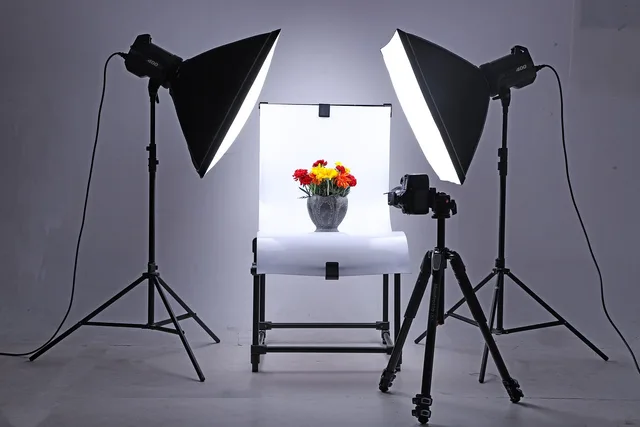
In-house removes the per-image fee but adds equipment, space and a diary slot. A basic kit such as a Canon EOS R50, a Godox SL60W light and Capture One tethering software typically costs £1,000 to £1,500 upfront.
Marketplace imagery from Amazon or eBay is cheapest and the weakest differentiator, because rivals use the same files. Amazon's image policy asks for a pure white background and at least 1600 px on the longest side for zoom.
Hybrid routes suit large core ranges and rotating seasonal lines. Shoot hero shots in-house or through a studio, then outsource the rest to Fiverr or Upwork. Read the product photography strategy and planning guide for 2027 before you split the work, since that split is where naming and rights conventions break.
Where unit cost and control pull apart
Cost per image is a poor opening question because it hides retouching, props, models, travel and re-shoots.
Cost per image hides the real bill
- £18per image, 60 products
- £1,080quarter at £18 an image
- £3,900same brief at specialist studio
- £880monthly internal prep cost
Illustrative example: 60 products a quarter at £18 an image costs £1,080. The same brief at a specialist studio charging £65 an image costs £3,900. The difference buys art direction, not extra pixels.
Internal time is the cost teams forget. One member of staff spending a day a week on preparation, at a fully loaded £220 a day, adds about £880 a month.
A lower per-image rate rarely means a lower cost per usable asset once re-shoots are counted.
Rights and accessibility sit outside the quote
Ask who owns the copyright and which media the licence covers. A website quote may exclude paid social or print, and reopening terms costs more.
Photography must sell the product honestly. The Consumer Rights Act 2015 requires goods sold to consumers to match their description. Flattering imagery beyond recognition creates avoidable returns.
Accessibility is a second check on the same files. The WCAG 2 overview sets the standard for text alternatives, and alt text is normally written by whoever commissions the shoot.
If you approach retailers or studio partners directly with marketing, the ICO guidance on choosing a lawful basis for direct marketing sets out what you need to document.
Matching the route to your catalogue
A product photography channel strategy depends on how long a product stays in the range and how many channels it appears on. Review the split each quarter: a route that looked efficient in January can be the bottleneck by June, and the review costs less than a re-shoot.
Most channel plans break on the same points, which the product photography strategy mistakes in England article sets out, so use it as a checklist before you sign a studio agreement or move a range in-house.
Short-lived ranges
Seasonal and trend-led products rarely earn back a studio booking. Shoot them in-house or through a volume provider such as Snappr or Splento on a rolling schedule, and accept a slightly higher unit cost to avoid a re-shoot.
Long-life core products
Core products sold for years across web, marketplace and print justify a commissioned shoot with a licence covering every channel. The per-image price matters less when one asset serves five placements.
Common questions
Which route is cheapest for a small catalogue?
Marketplace or supplier imagery, if the files exist and meet your quality bar. For a few dozen products a quarter, an in-house setup usually undercuts a studio once travel and scheduling are counted.
Do I need a written usage licence?
Yes, even for a long-standing supplier. The licence should name the media, territory and duration, because verbal assumptions about social or print use are the usual source of disputes.
How often should we revisit the route?
At least once a year, and sooner if returns rise or a marketplace changes its image requirements.